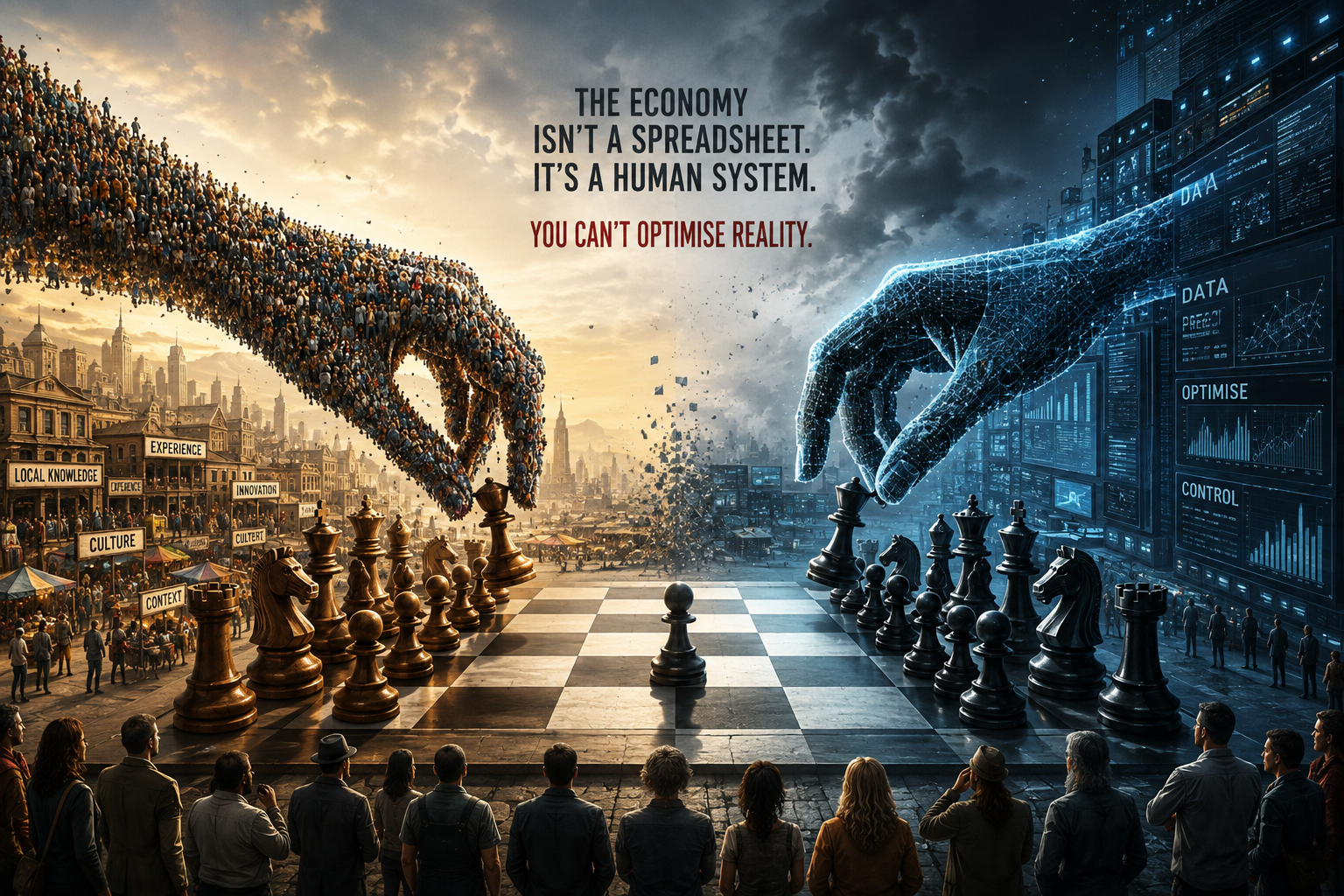
Following a comment I made and subsequent discussion on a recent FT.com article (Could AI revive the socialist dream?), I felt the need to extrapolate, if only as a release valve to my own cognitive expression on the theme. My view being that for decades, the strongest argument against central economic planning was not ideological but informational.
Hayek’s point that was central to the FT.com article that kicked this off, was simple; the knowledge needed to allocate resources efficiently is dispersed across millions of people, organisations and local decisions. Prices compress that messy reality into signals that allow the system to coordinate without anyone possessing the whole picture. AI appears to challenge that.
A sufficiently powerful system could ingest vast quantities of economic data, model supply and demand, optimise logistics and continuously adjust allocation decisions. The old objection that no central authority could possibly process enough information suddenly looks weaker, but that was never the whole problem.
An economy is not a static dataset. It is a complex and unpredictable, chaotic yet adaptive system. The moment an AI planner acts, people and organisations respond. Suppliers alter behaviour. Consumers change preferences. Companies game incentives. Competitors innovate around constraints. The intervention changes the environment the model was built to predict. Worse still, some economically important information does not exist until people experiment, fail, invent and discover it, compounding divergence.
AI may be able to optimise what is known but markets help discover what is not. Even then, AI still needs an objective function. Growth? Equality? Resilience? Sustainability? Consumer choice? There is no neutral mathematical answer without introducing bias and in so doing sending the whole train off the rails, again. So AI may weaken the computational case against central planning without defeating Hayek’s deeper argument. As I referenced in an earlier piece (AI Won’t Take Over the World, It May Just Destabilise It), Goodhart’s Law reminds us that once a measure becomes a target, behaviour adapts around it.
The real danger as I see it though may be more self-defeating. We could end up replacing millions of imperfect human decisions with millions of highly optimised machines, all trained on similar data, reading the same signals and reaching the same conclusion at roughly the same time. At which point we will presumably congratulate ourselves on eliminating irrational markets just before our perfectly rational algorithms stampede off the same cliff at machine speed.
Posted on August 30, 2026
0