Following a great day with at BIG SASIG and having the pleasure of speaking (Trust, Control & Resilience in an Era of Exponential Change) I enjoyed some stimulating discussions on one of the themes I raised. That of lessons organisations should be learning from their Cloud adoption experiences as they are now confronted with AI. There are many parallels, albeit AI introducing a ferocious machine speed element and how Cloud computing was once presented as an almost binary migration/adoption choice from the corporate data centre.
I suspect commercial AI consumption may be approaching a structural change that will echo a similar hybrid approach that cloud has settled into.
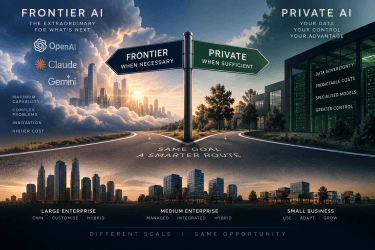
Timely to this theme, in the news once again I read of a trend that seems to be picking up, Latham & Watkins has bought its own Nvidia Graphics Processing Unit (GPU) infrastructure and is customising open weight models, partly to protect sensitive client information and gain flexibility over rising AI consumption costs. Yet importantly, it is not abandoning commercial frontier models. It intends to use both. That may be the clue to what comes next, frontier when necessary, private when sufficient. An echo of how cloud adoption has become established.
For large enterprises, particularly banks, law firms, governments and regulated industries, the economics and sovereignty arguments are increasingly compelling. High volume, predictable workloads such as document analysis, classification, summarisation and internal knowledge processing could run on privately operated models. While Frontier models remain available for complex reasoning, innovation and problems where additional intelligence justifies the premium.
Medium-sized enterprises on the other hand are unlikely to build GPU estates on Latham’s scale. Instead, private AI could arrive as managed infrastructure, sovereign cloud, dedicated GPU capacity, hosted open weight models and specialist models integrated with commercial frontier services. Their advantage will come from intelligent workload placement rather than infrastructure ownership.
For smaller businesses, the economics remain different. Frontier subscriptions and Software as a Service (SaaS) will usually be cheaper and simpler than owning AI infrastructure. However as my earlier experiment proved, which formed part of a piece wrote at the weekend (AI Won’t Kill the OS, It Will Make You Forget It Exists)., even amongst SME’s, increasingly capable smaller models running locally, at the edge or through low cost hosting could begin absorbing routine workloads and lower subscription costs and dependency.
Returning to the cloud analogy which is striking. Cloud computing reality became hybrid and multi cloud because economics, regulation, latency, resilience and sovereignty determined where individual workloads belonged. I suspect. AI will follow exactly the same trajectory, albeit at machine speed.
The future enterprise AI architecture may therefore be less about selecting the best model and more about continuously selecting the best model for the particular workload. That changes the economics of frontier AI. Open models do not need to replace frontier models to disrupt them. They merely need to consume an increasing proportion of routine inference.
There is also an uncomfortable question here for regulators too. Much emerging AI governance assumes that models remain identifiable, attributable and ultimately within reach of a provider capable of implementing safeguards such as watermarking, fingerprinting, provenance controls and usage restrictions. So the question is what happens when enterprises and eventually individuals, download open weight models, modify them and run them entirely on private infrastructure? Some will be deliberately uncensored, fine-tuned or stripped of their original safeguards. The regulatory challenge then shifts dramatically. You can fingerprint the model that left the factory but can you reliably identify what it becomes after someone changes the engine?
As I suspect AI follows cloud towards a hybrid adoption model and increasingly distributed deployment, regulators may discover that governing a handful of frontier laboratories was the relatively easy part. The harder problem will be governing millions of independently operated descendants that no longer need to phone home.
So, perhaps in there lies a warning for the frontier labs and more importantly, the investors queuing up for their IPOs. OpenAI and Anthropic and their ilk may be riding a powerful tailwind of optimism while failing to check the rearview mirror of technology history. Cloud taught us that enterprises rarely remain all in once economics, sovereignty and resilience enter the equation; hybrid wins. AI may be no different. The existential risk is not that open models become better than frontier models but that they become good enough for most things.
Frontier AI therefore may ultimately become the expensive expert you consult for the difficult problem, rather than the engine you pay to answer every question. The trillion dollar question is therefore not who builds the smartest model but who still gets paid for the tokens when everyone else has learned to run intelligence themselves.
Leave a Reply