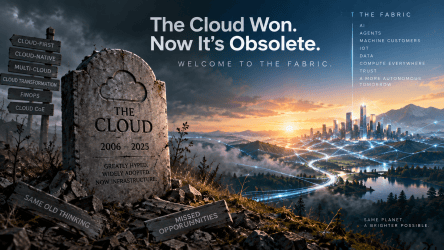
For the better part of two decades, the technology industry has performed an impressive trick, convincing boards that moving computing from one building to somebody else’s building constituted a strategic revolution. yes, for those of you who know me I have been part of that bandwaggon. To be fair though cloud genuinely changed everything. Infrastructure became elastic, software deployment accelerated, capital expenditure became operating expenditure and entire industries were reshaped. Oh yes there are still more than a few still playing catch-up. Then, inevitably, the slogans took over. Cloud 1st, Cloud native, Multi cloud, Sovereign cloud, FinOps, Cloud Centres of Excellence. It was a reminded of the Dot Com era when everything started to have a ‘.COM’ thrown at it.
At some point, the means quietly became the strategy. Now I am sensing the whole argument is becoming dated.
Satya Nadella’s own framing has moved well beyond traditional cloud language. This year has seen him described Microsoft as building a planet-scale cloud and AI factory, while also talking about AI platforms, Copilots, agents and sovereignty. Don’t get me wrong, Microsoft has not declared the death of cloud, that would be commercially inconvenient when Azure has just passed $100bn in annual revenue., but listen carefully to the language. Cloud & AI, AI platforms, Copilots, agents, model choice and agentic computing. Cloud is increasingly being repositioned from the destination to the substrate. Microsoft may still sell the Cloud, but Increasingly, I am sensing it is describing something else.
AI, autonomous agents, machine customers, IoT, edge systems and distributed intelligence are collapsing the distinctions between infrastructure, applications and users. Increasingly, the interesting question is not where computation happens, but how capability is assembled around an objective. It will take on new terms of reference like ‘Autonomous Digital Fabric’ or ‘Cognitive Digital Fabric’, I suspect this emerging environment will simply become known as ‘The Fabric’.
The Fabric is what comes after cloud stops being exciting it will encompass the expression of business objective, provide agent discover services, AI models on demand to reason over data and machine customers who will negotiate with machine suppliers. All running on compute that is acquired dynamically, APIs being invoked dynamically and devices responding to fulfil transactions. Providers may even be changed automatically according to cost, performance, sovereignty or trust.
Somewhere underneath all this, a hyperscaler will still be proudly announcing another availability zone. Nobody will care. That I fear is the uncomfortable part for an industry still selling ‘cloud transformation’ as though migrating another ERP system constitutes digital enlightenment.
Cloud of course as we know it does not disappear in the Fabric. It becomes infrastructure, important, ubiquitous and strategically uninteresting in much the same way electricity, powergrid’s, sub stations and now charging stations are strategically essential without boards spending quarterly meetings discussing transformer architecture.
The technology stack changes too. Infrastructure, platform, application and user give way to something more fluid, Identity, data, compute, (Intelligence, connectivity, agency and what everyone will become familiar with as the most important ingrediency, Trust. Capabilities in The Fabric become assembled temporarily around outcomes rather than permanently trapped inside applications.
Cyber security therefore faces a similarly awkward transition. The old question ‘is this system secure?’ increasingly becomes inadequate. The question of value becomes ‘Should this human, device or autonomous agent be trusted to perform this action, using this data and intelligence, at this moment?’ That requires continuous trust, machine identity, policy and assurance across interactions that may exist for seconds.
The next decade will not be about more cloud, believing that is like assuming the future of aviation depends on building better airports.
I have no doubt some organisations will still be debating their ‘cloud strategy’ when the market has already moved on to The Fabric. They will commission roadmaps, refresh governance committees and congratulate themselves on incremental progress while faster competitors quietly automate away whole layers of cost, latency and decision making. The danger is not that they fail to adopt the latest technology. It is that they fail to notice the basis of competition has changed at all. By the time they finally open their eyes, they may discover the transformation programme was successful, the milestones were green, the board pack was reassuring and the organisation itself is no longer commercially relevant.
Cloud was the architecture of digital scale, The Fabric I predict will be the architecture of digital autonomy and a new age; yes the cloud won but what an ignominious reward to become plumbing.
Leave a Reply