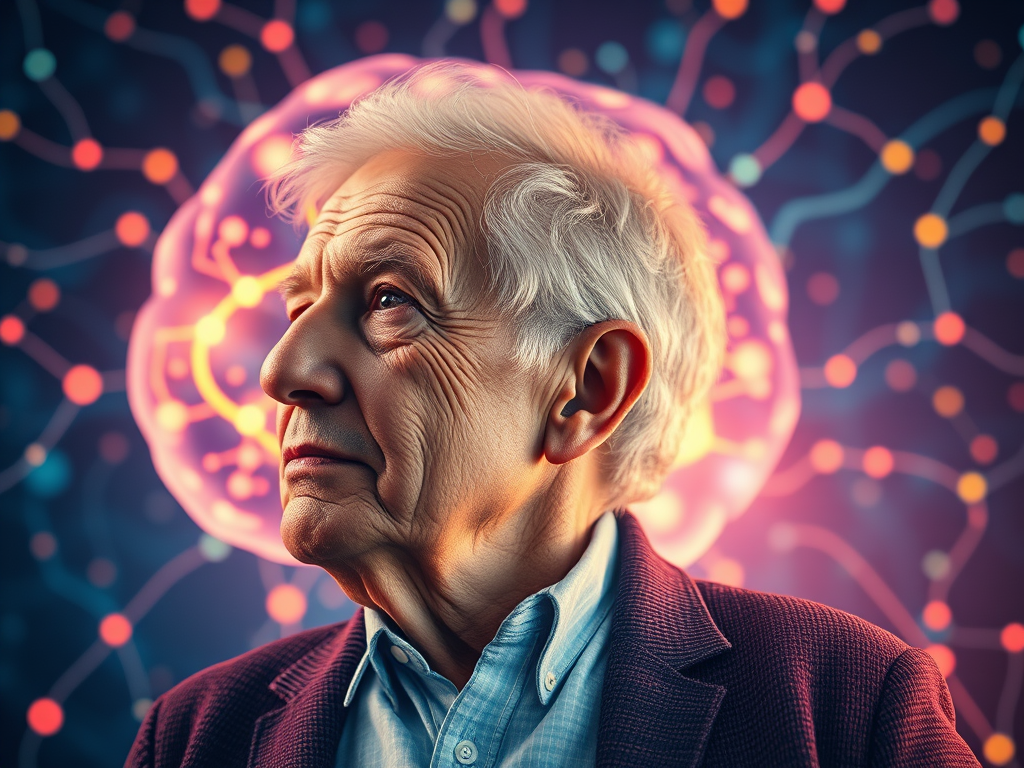
Following on from my last piece on Wasting Your Best Cognitive Assets, a challenge was presented in the form of, IF an aging population has such congestive ‘SuperPowers’, why are we not seeing it and recognising it spontaneously?
A fair challenge perhaps, but the response can be summed up in a well coined phase – use it or lose it or more realistically, it is in our social conditioning. With age often comes greater risk aversion and fear, natural by-products of experience and hard-won insight into what can go wrong. ‘Could’ becomes the operative word as possibility begins to outweigh reality and fear starts to restrain action across many dimensions of life. Reduced action increases stress; sustained stress undermines health; declining health then reinforces fear. Thus a self-reinforcing loop emerges, risk aversion born of good intent, compounding into poorer outcomes and, ultimately, a shorter and less fulfilled life. A perverse manifestation of what could be avoided by harnessing that cognitive horsepower into action.
So if the first half of your career was about acceleration, learning fast, proving yourself, saying yes, then the second half is about precision. For professionals over 55, the question is no longer ‘Can I keep up?’ but ‘How do I deploy my cognitive strengths deliberately, without burning them out?’ This goes for physical ability as well.
For business leaders reading this it is about how to build your teams to leverage this hidden capacity. Knowing that the foundations are sound,. Neuroscience, longevity science and lived experience converge on a reassuring truth, your mind is not in decline. It is reorganising. The opportunity is to work with that reorganisation, not against it, to adapt your captured intelligence to maximum effect over time.
For individuals, understand your cognitive shift and engage body and mind in a new roving gear.
The facts are that processing speed peaks between 18 and 25 years, after midlife, this speed may slow slightly, but other capabilities surge. Pattern recognition, strategic judgment, emotional regulation, ethical reasoning, and contextual intelligence often reach their strongest expression in later decades. These are not accidental by-products of aging; they are the result of accumulated experience being integrated into deeper mental models.
The mistake many professionals make is trying to compete on the metrics of their 30-year-old selves, speed, volume, constant availability. That is a losing game. The winning move is to change the arena. Redefine what peak performance means for you.
Your cognitive superpower is no longer constant intensity, it is selective intensity. High-performance states still matter, but they must be deployed deliberately. Short, focused bursts of deep work, complex problem-solving, or creative synthesis can deliver disproportionate value when paired with adequate recovery.
Think in terms of punctuation, not pressure. Peak states should accent your work, not dominate it. But to achieve this maintaining the foundations matters. Longevity research is unambiguous, cognitive performance after 55 is tightly coupled to physical and metabolic health. It means prioritising:
- Sleep as a strategic asset, not a luxury (min 8 hours)
- Strength and aerobic fitness, which correlate strongly with executive function
- Inflammation control through diet and stress management
- Sensory novelty, new environments, skills, or perspectives, to sustain plasticity
These are not wellness trends; they are performance infrastructure that enables you to use experience as a force multiplier. Modern cognitive and longevity science validates both intelligence shifts rather than declines with age, while peak states remain accessible but biologically costly. The optimal lifespan strategy is not permanent intensity, but mature cognition punctuated by deliberate, well-recovered flow. Flow is an optimal state of consciousness, you may know it in its other guises such as runners high or being in the zone.
Youth optimises speed >> Midlife optimises integration >> Later life optimises sense-making
Flow can occur at any age but sits within these layers. Your advantage lies in integration. You can connect dots faster because you have seen versions of them before. Lean into roles and activities that reward synthesis, mentoring, strategy, governance, advisory work, complex negotiations or systems design. Articulate your thinking. Write, teach, document, and mentor. Externalising experience strengthens your own cognition while creating leverage for others.
The key is in the balance, balancing challenge with recovery. The brain still responds to challenge but the recovery window matters more. Stress can sharpen cognition when it is acute and purposeful. Chronic overload, by contrast, erodes clarity.
So back to how to activate your cognitive superpowers, adopt a rhythm:
- Periods of cognitive stretch
- Followed by deliberate downshifting
- Anchored by purpose, not urgency
This balance is the difference between sustainable excellence and silent burnout.
Perhaps the most powerful shift is psychological, the reframing of your Identity and contribution. You are no longer defined by upward trajectory alone. Contribution, not progression, becomes the metric. This frees creativity, reduces fear of failure, alleviation from stress and unlocks originality. Tap into a renewed sense of purpose when you stop trying to outrun age and start working with it.
Remember, it is not automatic, it is designed and you are the architect. Your 50+ years are not about clinging to relevance; they are about deploying relevance with intent. When you maintain your foundations, choose your moments and lean into integrative intelligence, the result is not decline but a second cognitive peak.
The world does not need you to be faster. It needs you to be wiser, clearer and more deliberate than ever before.
After all, who else is going to keep the thirty-something AIs in line, if not those with enough experience to recognise confidence without context, speed without judgment and answers without wisdom?
Posted on December 23, 2025
0