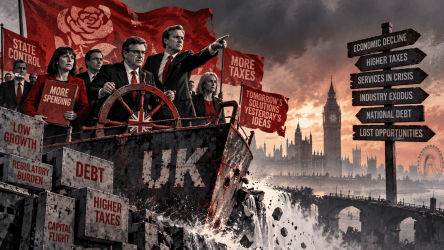
Excuse my off-roading from my usual digital and cyber themes (although I do tip my hat to a digital evolution), but the policy ambitions emerging from Labour’s conference this week have been hard to ignore and I felt the need to get this off my chest. So please feel free to click away … Those policy aspirations reinforce in me a real concern, now qualified fully in the evidence of intent, that here in the UK we may not simply have a leadership problem, but a political maturity problem. Too many proposals appear to put party instinct, ideological inheritance and political signalling ahead of affordability, execution and the long-term national interest. That is the danger of B-grade politics comprising conviction without sufficient discipline, ambition without enough realism and nostalgia dressed up as strategy. Britain has more urgent challenges than walking backwards into the future squinting through rose-tinted glasses. An expensive return to yesterday is no answer to tomorrow. The country needs politicians capable of writing its next chapter, not endlessly reopening the last one.
Labour is merely the latest government to discover that running UK Plc is rather harder than campaigning to take control of it. The problem is not simply ideological; it is the widening gap between political ambition and economic reality. Previous governments made plenty of mistakes, but this administration increasingly gives the impression of pressing harder on the accelerator while arguing about the map. Policy after policy is being advanced with insufficient regard for investment, competitiveness, productivity and the cumulative burden on the economy. The danger is not one bad turn, but a succession of politically satisfying decisions that compound into something far harder to reverse. Governments do not get to suspend economic gravity simply because the destination sounds virtuous, eventually the bill arrives and more often than not someone else has to foot it.
Earlier generations of politicians were disproportionately shaped by war, national service and circumstances in which difficult decisions carried immediate consequences. That did not make them infallible, but it often gave them experience of responsibility beyond party management and personal survival.
Today’s political environment is very different. Ministers operate under relentless media pressure, collapsing political time horizons and extraordinary levels of churn. The Institute for Government has repeatedly warned that high ministerial turnover damages effectiveness because ministers barely master their briefs let alone develop meaningful experience on which sound judgment can be built before moving on. In the September 2025 reshuffle, more than half of ministers either changed role or left government. Albeit some due to fraud or other questionable behaviour!
The deeper concern I feel is what this does to judgement. If the problem is no longer simply who governs, but how weakly citizens can constrain those who govern between elections, then leadership reform alone is not enough.
That raises a wider question in our digital age, should citizens really be expected to exercise meaningful democratic control only once every 4 or 5 years and then largely surrender the field to parties operating on increasingly fragile mandates? Switzerland offers one model, where citizens can force national votes through popular initiatives and referendums; Ireland offers another, using randomly selected Citizens’ Assemblies to examine complex issues, hear expert evidence and make recommendations to government. Britain need not copy either wholesale, but a modern hybrid could provide a powerful constitutional pressure valve, whereby citizens can initiated referendums for questions of sufficient national significance, combined with independently constituted citizens’ forums to test the evidence before the vote. The point would not be to replace Parliament, but to constrain political overreach and reconnect major decisions with informed public consent. In an era when citizens have unprecedented access to information, it is increasingly difficult to justify a democratic model in which their effective authority is concentrated into a single cross on a ballot paper every few years.
When politicians feel permanently vulnerable (not only from external party forces but in Labours case from the majority of their own commercially inexperienced and economically wilfully blinkered backbenchers), decisions risk becoming emotional and defensive; protecting reputation, faction, leadership position or party polling rather than asking what serves the country over ten or twenty years. Biosecurity, defence, infrastructure, cyber resilience and national competitiveness all demand precisely that longer horizon.
My view is that leadership is ultimately the ability to subordinate ego, emotion and immediate political advantage to responsibility. Andy Burnham’s recent reflections on his father’s dementia and experience of social care are entirely understandable and personal experience can give political leaders valuable insight into the human consequences of public policy. There is however an important distinction between allowing experience to inform judgement and allowing emotion to drive it. A Prime Minister must test deeply personal convictions against evidence, competing national priorities, affordability and the interests of millions whose circumstances may be very different. That is one reason the scrutiny and tempering of a demanding electoral contest matters; leadership at this level should demonstrate the capacity to move beyond personal experience and party instinct towards mature national judgement. Empathy is an important quality in government but it cannot substitute for analysis. The test of leadership is not how strongly a policy resonates personally, but whether, once emotion has been stripped away, it remains the right decision for the country.
Burnham may have looked like Labour’s safer harbour as the Starmer government foundered, but that should not be confused with proven national leadership. He has substantial political experience but principally at a local level, yet remains relatively untested in the uniquely unforgiving disciplines of prime ministerial office, national security, international crisis management, fiscal trade-offs and decisions where empathy cannot be allowed to outrun evidence. The question is therefore not whether he is a decent or compassionate politician, but whether he can demonstrate the maturity of judgement to put country before party, personal conviction and political survival.
A government constantly fighting for its own survival may eventually forget that its purpose is not to preserve itself, it is to govern.
Leave a Reply