HAPPY NEW YEAR …
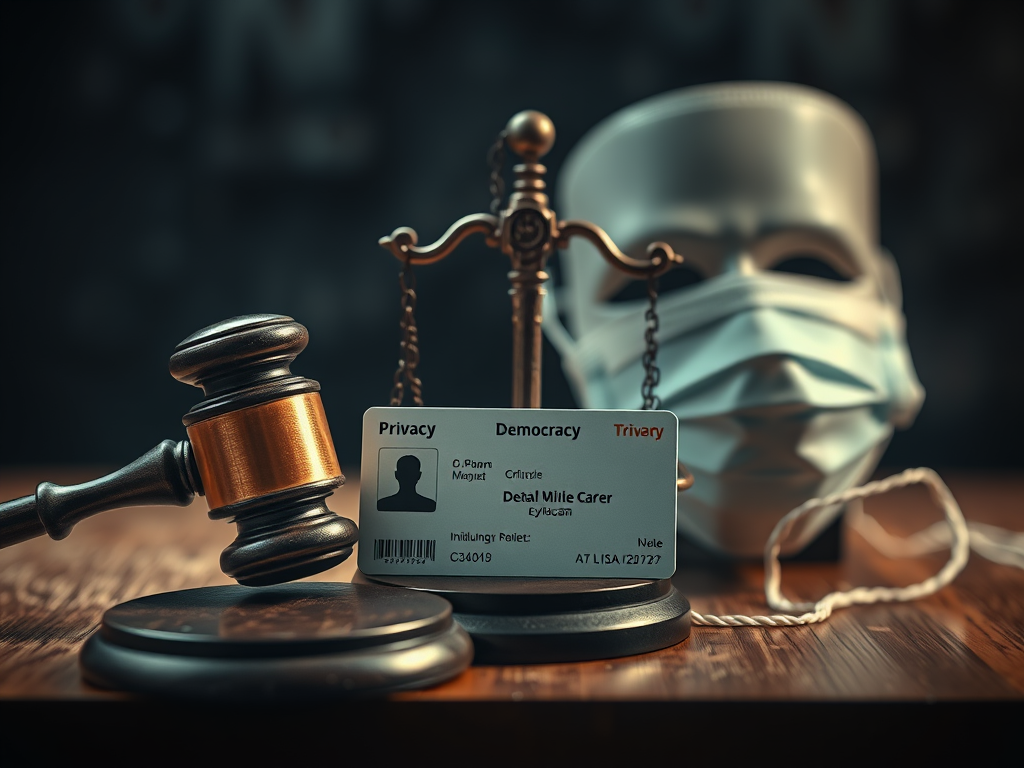
The papers are full of the usual headline grabbing alarmism in the annual post mortem roll-up of opinions on the economy amongst other themes. For me areas of the social balance sheet that are being ignored include where Britons may be getting poorer include Privacy, Democracy and Justice. For the purposes of this missive, I roll these themes up under ‘Liberty’.
Most erosions of liberty do not arrive with sirens. They arrive wrapped in language of efficiency, modernisation and pragmatism. They come as sensible responses to backlogs, fraud, disorder or technological inevitability. Each step, taken alone, appears reasonable. Taken together, they can quietly rebalance power away from the citizen and towards the state.
Recent policy directions in the UK around digital identity, facial recognition, delayed elections and limits on jury trials should be understood in this light. Not as evidence of authoritarian intent as I genuinely believe the current politicians in charge lack that cohesion of purpose, but as the laying of foundations that future governments, of any colour, could exploit with far fewer constraints than exist today.
Let’s get one thing straight, this is not about conspiracy. It is about architecture. Think of the freedom to drive wherever you like, stopping and starting and even going off road to forge a novel pathway and compare this with the constraining dependency of being on rails like a train.
Now reflect on a compulsory or near-compulsory digital identity system. This also fundamentally changes the relationship between the individual and the state. Identity ceases to be something you present selectively and becomes something that mediates access to work, services, housing and potentially much more. Shifting you from rights to rails.
Even when well designed, such systems create infrastructure lock-in. Once most citizens depend on a single identity rail, opting out becomes economically or socially punitive. Over time, pressure grows to reuse the system for adjacent purposes. This is not mission creep driven by malice, but by convenience and cost logic.
The risk is not that government instantly becomes oppressive but that refusal, anonymity and friction, historically important checks on power, become harder to exercise.
Then there is the shift from observation to identification. Where facial recognition represents a more profound change. Traditional surveillance recorded behaviour; biometric surveillance identifies people. The difference matters. In public spaces, consent is largely illusory. You cannot meaningfully opt out of having your face captured if the camera is on the street. Even if current use is limited to watchlists or serious crime, the capability exists to normalise identification in everyday life. This has a chilling effect long before abuse occurs. People change behaviour not only when surveillance is misused but when it is believed to be pervasive. Protest attendance, civic engagement and lawful dissent all suffer when anonymity disappears from public life.
Democracy depends not just on free speech, but on unobserved assembly.
Then there is the manipulation of elections as rights to elections as events. Delaying or cancelling elections, especially inaugural ones, may be administratively convenient. But democracy relies on the principle that elections happen on time, regardless of inconvenience.
Once elections are treated as events that can be rescheduled for programme management reasons, a dangerous precedent is set. The question quietly shifts from ‘Can the public vote?’ to ‘Is the system ready?’, a judgement controlled by those already in power.
Trust a subject I have written about as so pivotal in our digital age, once lost, is difficult to restore. Democracies do not usually collapse because elections stop entirely; they decay when elections feel adjustable and due process is no longer trusted.
The latest aberration is in attitudes towards justice as a safeguard to justice as mere throughput. The idea of curtailing jury trials to address court backlogs is perhaps the most troubling shift. Jury trial is not a luxury feature of the justice system; it is a constitutional safeguard that places ordinary citizens between the accused and the state.
Efficiency pressures have a habit of spreading. What begins as a limited carve-out for minor offences can widen over time, especially when performance metrics prioritise speed and capacity. Procedural protections are rarely restored once removed.
Justice systems optimised for throughput will likely disadvantage those with the least power, resources or confidence to resist.
Bring all of this together and you start to see why the combination matters. Each of these developments might be survivable on its own. Together, they form a reinforcing pattern:
- Identification becomes unavoidable
- Anonymity in public life erodes
- Democratic accountability becomes more elastic
- Procedural safeguards weaken under efficiency pressure
This is how societies become poorer in liberty not through dramatic rupture but through gradual re-engineering.
So as we say goodbye to 2025 and welcome in 2026, let us write a note to self, without grandstanding, to engage more proactively, as it is only our collective voice that will preserve our liberty. The response need not be alarmist, nor partisan but it does require engagement. Here are some ideas to get you started:
- Insist on limits, not assurances – Trustworthy systems rely on enforceable constraints, not promises of good behaviour. Ask: What legally prevents misuse? What penalties apply? Who audits independently?
- Support privacy-preserving design – Digital identity does not have to mean total disclosure. Demand minimal-data credentials, attribute-based proofs and strict purpose limitation.
- Treat elections as sacrosanct – Push back, politely but firmly, against normalising election delays. Remind your Member of Parliament (MP) that ‘Administrative difficulty is not a sufficient justification.’
- Defend jury trial as a default – Even if reforms proceed, argue for the defendant’s meaningful right to elect jury trial in contested cases.
A final thought, technological progress and administrative reform are not enemies of liberty, but history shows that freedom is rarely lost in a single act. It is lost when safeguards are traded away, one by one, for convenience, until there is nothing left to trade.
The responsibility of a free society is not to reject change but to shape it so that power remains constrained, accountable and ultimately answerable to the citizen. Engage locally, not just online. Start by writing to MPs, attend consultations, support civil liberties organisations. Quiet, persistent scrutiny is more effective than outrage.
Once those constraints are gone, rebuilding them is far harder than defending them in the first place. Think long-term, beyond this government, the question is not whether today’s ministers are trustworthy, but whether tomorrow’s might not be.
Posted on January 1, 2026
0