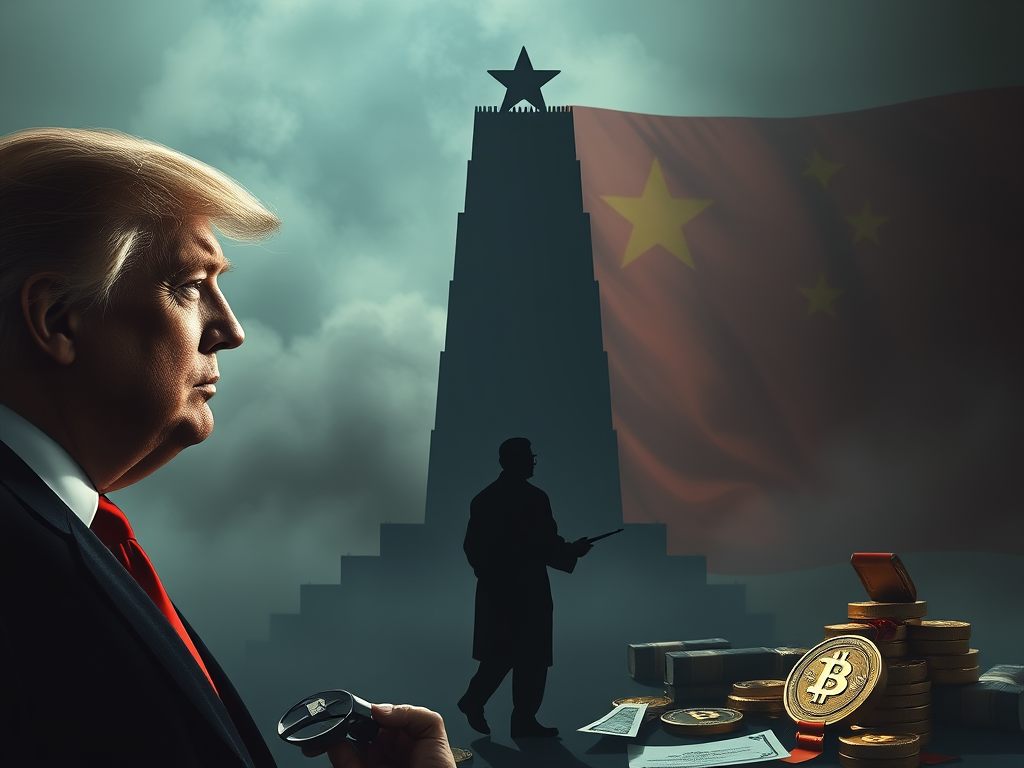
Donald blinked first with his 90 day tariff reprieve for most but China get a further hit from 104% to 125%.
If the world thought there was any parity of treatment then that veil has fallen for sure. The 125% uplift lights the afterburners on the U.S. <> China trade war, Beijing is no doubt weighing its options as the economic battlefield is evolving faster than dear Donald may be expecting. China is not merely reacting to his tariffs, it is recalibrating the global financial order using a combination of traditional monetary tools, hard assets like gold, and the opaque reach of cyber operations. One can only hope that Trump and his cohort are not blind to the structural shift that has taken place within ‘The Party’ in China. Xi Jinping is no Deng Xiaoping, the direction of travel is very much Mao Zedong, (when drawing a tiger, you can sketch its skin but not its bones; when knowing a person, you can see their face but not their heart), a subject for another day …
Corporate and national security leaders must prepare for a future where currency, capital and code are fused into a new kind of strategic arsenal.
While tit-for-tat tariffs are expected, China has far more potent weapons in reserve. Chief among them its vast holdings of U.S. sovereign debt and, increasingly, its stockpiled gold. China holds around $760 billion in U.S. Treasuries, making it the second-largest foreign creditor to Washington. While selling off these assets would be costly to Beijing, doing so at scale, or even threatening to, could spike U.S. interest rates, destabilize financial markets, and weaken the dollar. Rumours already suggest China is testing the waters: U.S. Treasury yields have climbed in recent weeks, with investors noting an unusual sell-off in what’s typically a safe-haven asset.
A full-scale Treasury dump, the so-called “nuclear option” could damage U.S. public finances by pushing up borrowing costs. Mortgage rates, corporate lending, and federal deficits would all be affected. At the same time, it would rattle global markets, trigger equity sell-offs, and force the Federal Reserve to intervene as a buyer of last resort. But Beijing’s financial arsenal doesn’t stop at Treasuries.
China’s silent weapon is less visible but arguably more strategic is its gold position. Officially, the People’s Bank of China reports holding just over 2,200 tons of gold. Unofficially, analysts believe the real figure is far higher, between 5,000 and 6,000 tons, accumulated through quiet, long-term purchases. Meanwhile, Chinese civilians are estimated to hold over 20,000 tons of gold, the product of a state-supported culture of precious metal accumulation.
This matters now more than ever. For the first time in recent memory, gold-to-GDP ratios are approaching parity across major economic blocs, including China, the U.S., Russia and the EU. This puts gold in play as a strategic hedge against fiat volatility and, more provocatively, as a potential reserve currency anchor.
Should Beijing choose to escalate beyond Treasuries, it could pair a sell-off with a symbolic or partial gold backing of the yuan, perhaps through its maturing digital currency infrastructure. Combined with de-dollarization efforts across the BRICS bloc and Belt and Road nations, such a move would threaten the dollar’s role as the world’s reserve currency.
The other escalation route of a coordinated sell-off with fellow U.S. creditors may have cooled with the tariff pause, but perhaps a controlled devaluation of the yuan to offset tariff impacts may gain weight, both of which are plausible amid deepening geopolitical rifts.
For the U.S., mitigation would likely involve Federal Reserve bond-buying to stabilize yields, allied debt absorption and accelerating domestic supply chain reshoring to limit economic reliance on China. The US/Western China supply chain decoupling has been going on for a while now and not unique to this round of tariffs but picking up momentum. The recent forced decoupling China imposed on Australia a few years ago showed how volatile this is to economies. With Australia sourcing new markets in Asia relatively quickly and China being left without a significant source of energy imports amongst others. But this is a side story to the irreversible breakdown of global meta supply chains which will lay the groundwork for new global economic supply chains that will rewrite the rule book. A subject I touched on last week – Supply Chain Data Threatens Trade, Tariffs & UK Digital Sovereignty
Still, the underlying shift is clear, the U.S. <> China rivalry has entered a financial phase, with traditional trade tools now joined by monetary brinkmanship.
Yet there’s an even subtler front emerging, one embedded in the machinery of modern markets, market chaos by algorithm. As financial warfare intensifies, cyber-enabled tactics could offer China a powerful force multiplier.
Global finance runs on algorithms. High-frequency trading, automated hedging, and microsecond arbitrage have made electronic markets exquisitely sensitive to volatility and misinformation. China, with a deep bench of state-aligned cyber operators and access to global economic telemetry, could exploit this ecosystem through non-kinetic, deniable disruption.
Tactics might include:
- Triggering algorithmic sell-offs by spoofing market signals or manipulating financial news flow to distort sentiment.
- Deliberate latency attacks on key trading infrastructure, price feeds, order books, or routing systems, to erode trust in the integrity of U.S. markets.
- Simultaneous disinformation and Treasury manoeuvres, using digital tools to exaggerate market panic and prevent rational hedging.
Such actions wouldn’t need to crash systems. Just a few seconds of disruption could trigger billions in automated losses or margin calls. In effect, China could use code to amplify capital pressure, shaking confidence in the dollar and U.S. market stability.
For the U.S., defending against this hybrid threat means going beyond cybersecurity, it requires financial system resilience. That includes real-time monitoring of algorithmic anomalies, cross-sector drills between exchanges and national security agencies, and rethinking what financial deterrence means in an era where economic pain can be delivered without a single missile or troop movement.
Code, Capital and Confrontation, the clash between the world’s two largest economies has moved beyond tariffs into the deeper currents of monetary, technological and strategic competition. China’s dual arsenal of U.S. debt and gold, paired with cyber-enhanced disruption, presents a multi-domain challenge to U.S. economic primacy.
In the new era of great power rivalry, the battlefield is financial (bonds and gold), the weapons are algorithmic and the stakes are global.
Posted on April 11, 2025
0