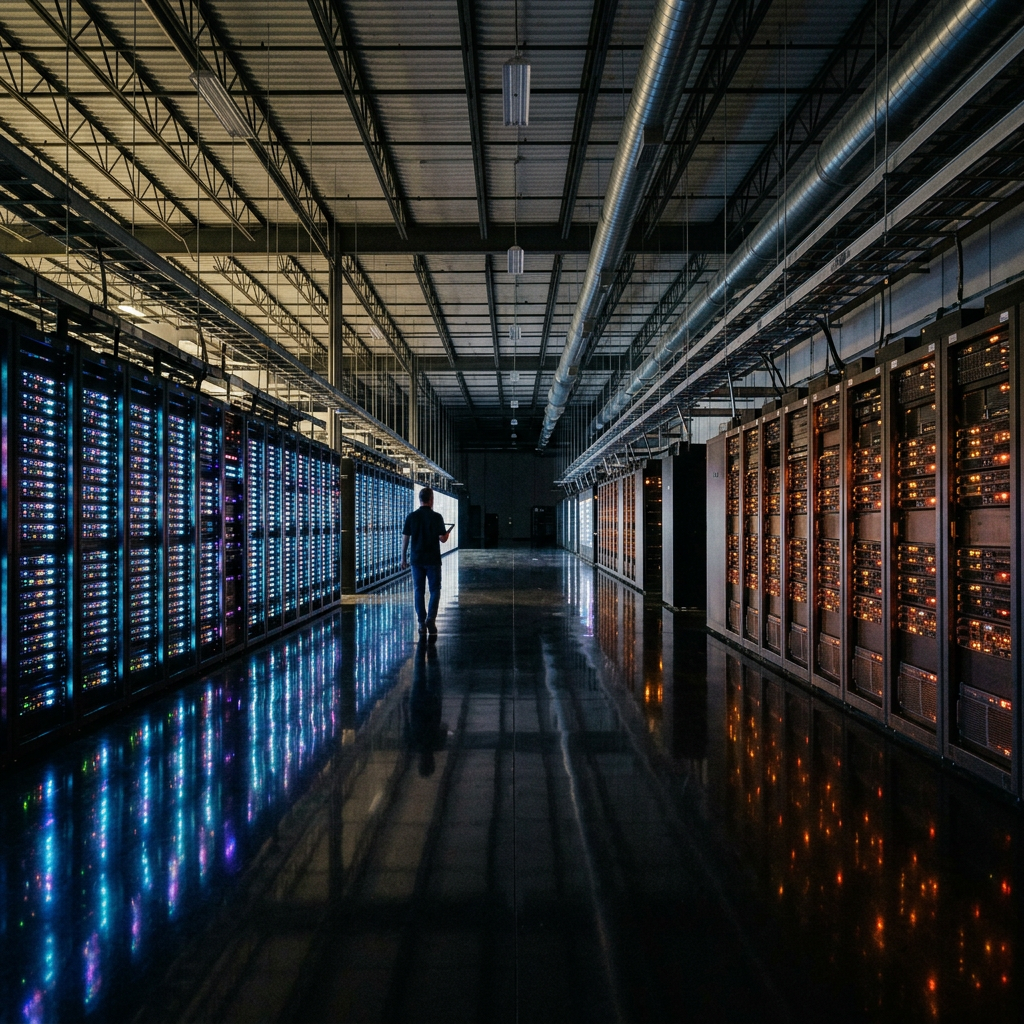
Another weekend and another headline prophesying the AI bubble is nigh. Much of the current AI bubble debate it appears to me is still focused on the visible layer, that of GPU shortages, hyperscaler capex, power consumption, small modular reactor (SMR) nuclear powered data centres and trillion-dollar semiconductor valuations. The market narrative largely assumes the risk sits in whether AI adoption justifies the scale of infrastructure being built.
When I feel the crowd fixated in one direction I find myself checking over my shoulder and what that does here is suggest that AI adoption may not be the real market driver at all. This is despite the increasing failure rates being reported of organisations ability to tap the heralded potential of AI … which I do believe is simply evolutionary in its dynamics that I put down to current organisational immaturity and the old optimisation v. transformation chasm in adoptive attitudes to technology disruptions.
What the market may be underestimating, yes that is a bold claim but hear me out, is that AI optimisation changes the entire equation. As I wrote about earlier in – The Illusion of Efficiency, Why Cheaper AI Will Consume More of Everything. If the cost of intelligence collapses faster than expected through optimisation in the use of inference chips, TurboQuant compression, ‘Speedata’ analytics efficiency, model distillation, synthetic data and heterogeneous compute fabrics, amongst others, then value rapidly migrates upward in the stack. From raw compute to orchestration, to inference efficiency, to trust, to distribution and ultimately to control of decision making systems.
That is why DeepSeek mattered so much psychologically when it broke onto the scene as I wrote about in 2025 – When Less Becomes More, Can AI Algorithmic Minimalism Topple GPU Dominance?. It demonstrated that frontier level engineering and capability may not remain exclusively tied to unrestricted hyperscale compute ownership or latest generation CPU class availability. It is the efficiency in engineering itself that becomes strategically disruptive.
This creates a dangerous blind spot in current market thinking. Investors may still be valuing AI infrastructure and hyperscalers stacks as though scarcity of compute and capability remain the dominant economic constraints, precisely as the industry starts engineering scarcity out of the system.
Historically, infrastructure eventually commoditises and specialist ‘Neoclouds’ start to steal the thunder from the platform breadth players. This is not new, reflect back to the railways, fast forward a bit to telecoms, next bandwidth (internet boom/bust) and most recently cloud compute and storage. Why is current market behaviour acting like AI is going to be any different? Historic behaviour is repeating itself as durable value migrates toward the orchestration layer controlling how the infrastructure is used. That is where the current AI race becomes strategically fascinating. The winners may not simply be those who built the most compute. They may be those who learned how to make intelligence portable, efficient, trusted and economically scalable faster than everyone else.
What I see optimisation changing is the source of novel competitive advantage. For the last decade hyperscalers have been winning because they accumulated overwhelming advantages in global infrastructure scale, their proprietary data centre engineering driven by capital access and ultimately operational gravity. AI initially reinforced that dominance because frontier model training appeared to require near unlimited compute scale and hyperscale economics. AI is after all born of the cloud.
However, optimisation technologies I suggest are eroding the assumption that bigger automatically means better. If these AI efficiencies become the dominant drivers of AI economics, then smaller, more focused NeoCloud operators suddenly become strategically viable. They do not need to outbuild AWS, Microsoft or Google, they will out run them. Where the hyperscales become bogged down by enormous legacy gravity, NeoClouds are emerging natively focused around AI era assumptions of inference first economics, specialised accelerators, tightly optimised software stacks, sovereign deployment models, low-latency edge fabrics and highly tuned orchestration layers. In effect, the market may be repeating a familiar technology cycle, remember mainframes vs distributed compute? Then there was the telecom incumbents vs internet-native platforms, traditional hosting vs hyperscale cloud that is now potentially hyperscale cloud vs AI-native compute fabrics.
Don’t misinterpret me, the strategic risk to hyperscalers is not that they disappear, after all their scale, ecosystems and enterprise trust remain immense. The risk is that AI value migrates upward away from generic infrastructure consumption toward highly optimised intelligence serving layers where agility matters more than sheer estate size.
This is particularly important for what I am increasingly thinking of in terms of inference economics. Training may remain hyperscaler heavy for some time but inference becomes a margin optimisation war. If NeoClouds can deliver materially lower cost-per-token or sovereign/localised AI execution models, they will begin abstracting customers away from underlying hyperscaler dependency altogether, or put more sharply:
AI advantage = intelligence (validated useful work) delivered per watt, per token, per Pound/Dollar (GBP/USD), per unit of trust.
Paradoxically, the hyperscalers may have partially created the conditions for this disruption themselves. By standardising infrastructure so successfully, they made compute increasingly portable and gave birth to AI as a viable massive scale technology. AI optimisation may now complete that abstraction layer.
I suspect though that if NeoClouds begin capturing the optimisation through inference and sovereign AI layers where future economic value migrates, hyperscalers may respond in familiar ways. I see echoes of what social media platforms repeatedly did during shifts in mobile, messaging, video and what become known as the creator economy / economies. AI infrastructure may now be entering a similar consolidation cycle around optimisation and inference economics, whereby incumbents often buy the next control layer rather than rebuild their entire economic model from scratch. What we could see is hyperscalers strategically buying into or partnering with NeoCloud operators to maintain relevance in an AI economy shifting toward optimisation first architectures, triggering a period of accelerated market consolidation, effectively absorb innovation at the edge of the market to prevent value migration away from their platforms.
The irony is almost brutal, the more successful AI becomes at optimising intelligence, the more it may undermine the economics of the infrastructure boom currently funding it, creating a future that will quiet possibly involve trillion dollar hyperscalers desperately acquiring startups whose core innovation was discovering how not to need trillion dollar hyperscalers in the first place!
Posted on May 17, 2026
0