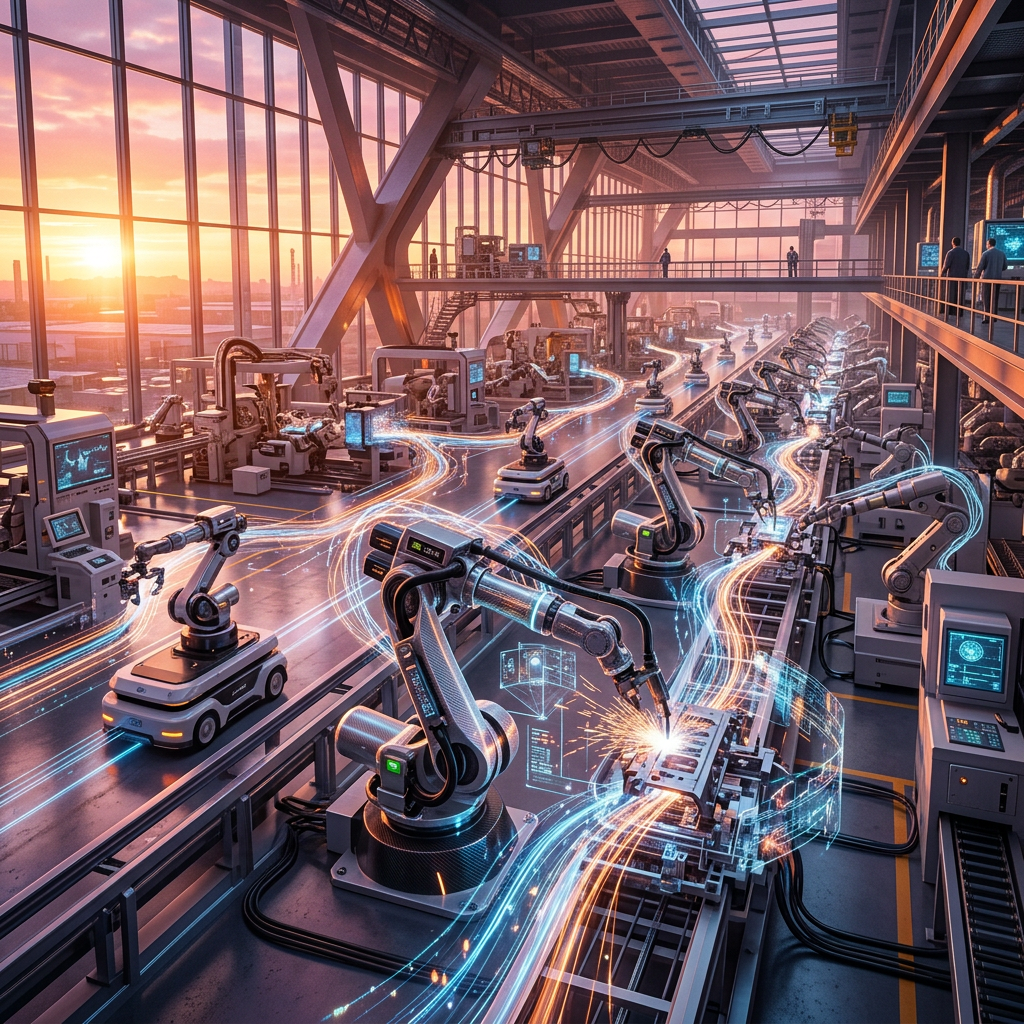
Artificial Intelligence (AI) is no longer simply another technology cycle. It is becoming an exponential accelerant acting upon every other domain it touches. Unlike previous waves of transformation that largely evolved in isolation, AI is creating connective tissue between disciplines, systems and industries that were never originally designed to converge. The result is not linear change. It is compounded systemic acceleration.
Historically, technological progress followed relatively understandable evolutionary paths. One breakthrough enabled the next over decades, sometimes generations. Organisations, governments and societies had time to absorb the consequences, restructure institutions and retrain people. Human cognition itself evolved around this cadence. Our brains are wired for sequential reasoning, progressive adaptation and incremental risk assessment. We instinctively think in straight lines while exponential systems behave in curves. AI changes that equation entirely.
What makes this era different is not simply the intelligence of the models but their ability to amplify and orchestrate capability across unrelated domains simultaneously. AI is linking robotics with biotechnology, cybersecurity with autonomous systems, finance with predictive analytics, materials science with simulation, and energy systems with real time optimisation. Each advancement strengthens another. Each breakthrough lowers the barrier for the next. Entire sectors begin reinforcing one another in ways never envisaged by their original architects.
This is the true danger and opportunity of exponential compounding. In the early stages, the curve disguises itself. Progress appears manageable, even overhyped. The impacts feel incremental because the visible outputs remain within familiar human frames of reference. Yet underneath, capability accumulation compounds quietly until the curve enters its vertical ascent. However time is short, we are now approaching the crook of that curve and the velocity is going to be unlike anything imaginable.
The uncomfortable reality is that many organisations still govern themselves with leadership models built for industrial age stability rather than exponential volatility. Strategic planning cycles measured in years struggle to comprehend environments transforming in months. Hierarchies designed for control cannot adapt at the speed of decentralised machine driven intelligence at machine speed. Entire industries risk becoming structurally obsolete not because they lacked capability but because they lacked the leadership imagination to guide transformation before the curve turned vertical.
The next decade is unlikely to resemble digital transformation as we understood it. It may represent the beginning of continuous civilisation scale reconfiguration, where the pace of technological convergence exceeds humanity’s institutional ability to process it rationally.
Ironically, the greatest risk may not be that machines become more intelligent than humans but that humans remain psychologically linear while the world around them becomes irreversibly exponential.
The organisations and leaders who learn to repattern their thinking, see beyond the exponential event horizon we are crossing and act before the curve becomes visible to everyone else and forces their hand, may not simply survive this transition, they will help define the architecture of the next economic and societal age.
Posted on May 26, 2026
0