Elon Musk’s SpaceX has confidentially filed a draft prospectus to regulators, which could mean it’s considering an Initial Public Offering (IPO) as soon as July 2026.
The race to build orbital data centres and space-based AI infrastructure has now truly begun. As SpaceX seeks permission to launch up to 1 million solar‑powered satellites engineered as orbital data centres and engineers study how to move energy-hungry computing to space, this may no longer be palmed off as science fiction. However, beneath the excitement lies a growing systemic risk few organisations are discussing yet and it will become a major feature in the protection of the fragility of Earth’s orbital environment itself.
As hyperscalers and space operators explore moving energy-hungry compute workloads into orbit, the conversation is understandably dominated by opportunity. Near continuous solar power, reduced terrestrial energy dependency, global low-latency connectivity and sovereign AI ambitions all present compelling advantages. Yet the underlying physical environment these ambitions depend upon is becoming increasingly congested, contested and unstable.
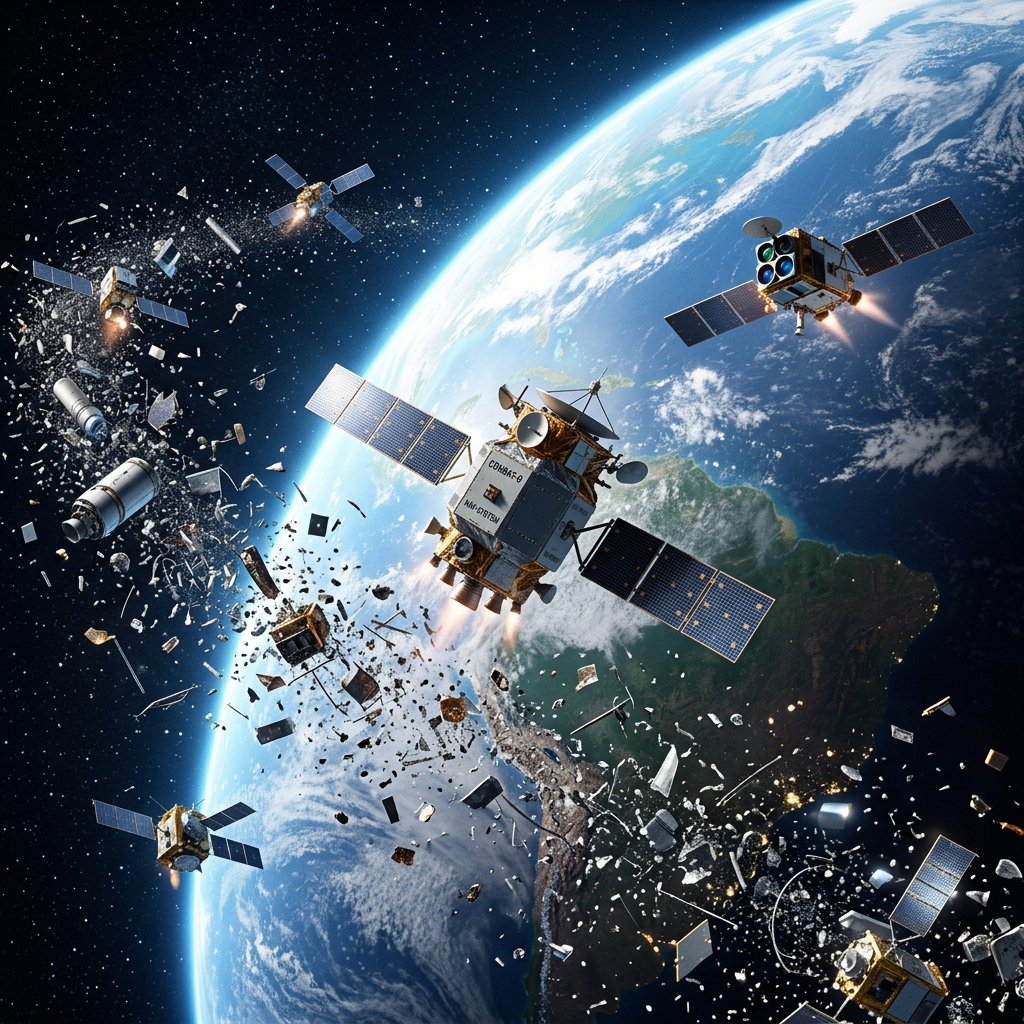
At the centre of this concern is the growing probability of Kessler Syndrome, a cascading chain reaction where collisions between satellites generate debris that triggers further collisions, exponentially increasing orbital fragmentation. In practical terms, orbit risks becoming a self-polluting environment. 2024 saw several major fragmentation events as well as many smaller ones, together adding thousands of new debris objects, underlining the need for prevention by implementing passivation and reduced orbit lifetime measures, according to the European Space Agency in their annual report.
This is no longer a theoretical academic issue. Tens of thousands of satellites are already planned across commercial, military and sovereign constellations. Add orbital compute platforms, autonomous servicing systems and AI-driven space infrastructure and the density of low Earth orbit begins to resemble critical infrastructure operating without meaningful global traffic management. See for yourself through the lens of the OrbitalRadar.com real time tracker.
The risk is systemic. A major debris cascade would not simply affect space companies. It could simultaneously disrupt:
- communications
- GPS
- financial timing systems
- weather forecasting
- defence capability
- future AI infrastructure
In effect, digital resilience is becoming physically coupled to orbital sustainability.
There is also a cyber dimension emerging. Orbital compute platforms create concentrated trust dependencies where software integrity, autonomous control systems, firmware assurance and supply chain validation become existential concerns. A compromised orbital platform cannot simply be patched by dispatching an engineer.
This is why the future debate around AI infrastructure is not merely about compute capacity. It is increasingly about governance, resilience and trust in a finite orbital ecosystem that humanity is rapidly industrialising before it fully understands how to protect it.
Oh yes, don’t get me started on the sovereign dependency risks, which may become far greater, not smaller. Nations may soon discover that AI sovereignty no longer depends simply on terrestrial cloud providers/environments, but on control of orbital infrastructure, launch ecosystems and space-based compute networks a new geopolitical layer sitting above today’s cloud sovereignty debates.
Perhaps the ultimate irony is that after years debating data residency on Earth, we may soon discover our most critical sovereign workloads are circling the planet at 17,000 miles per hour owned by someone else.
Posted on May 10, 2026
0