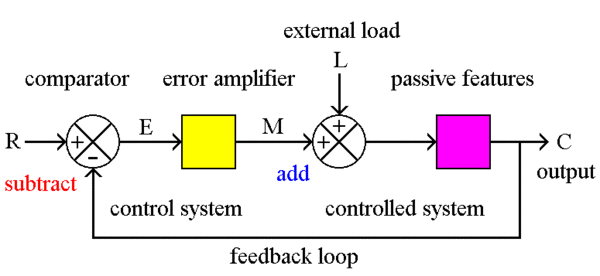
The integration of Artificial Intelligence (AI) into Industrial Control Systems (ICS) brings immense benefits but also significant accountability challenges.
AI for industrial control systems refers to the use of artificial intelligence (AI) techniques to enhance the performance, efficiency and reliability of industrial automation and production systems. AI solutions can be applied to various aspects of industrial control, such as sensor fusion, model predictive control, self-optimizing machines, collaborative robots, and factory supervision and optimization.
As AI systems gain more autonomy, ensuring that they operate transparently and responsibly becomes crucial. Current regulations and legislative efforts are steps in the right direction, but continuous evolution is needed to address the complexities of AI in ICS (Industrial Control Systems) fully. Policymakers, industry stakeholders, and technology developers must collaborate to create robust frameworks that balance innovation with accountability, ensuring that AI systems in industrial settings enhance productivity without compromising safety and responsibility.
This issue is becoming increasingly critical as AI systems in ICS take on more autonomous roles, influencing critical infrastructure sectors like energy, water, transportation, and manufacturing.
Implications of AI in Industrial Control Systems (ICS):
Enhanced Efficiency and Automation – AI enhances the capabilities of ICS by providing real-time data analysis, predictive maintenance, and automated decision-making. This leads to optimized operations, reduced downtime, and increased productivity. For instance, AI-driven predictive maintenance can foresee equipment failures, allowing for timely interventions that save costs and prevent disruptions.
Security and Risk Management – AI can significantly improve the security of ICS by detecting and responding to cyber threats more rapidly and accurately than traditional methods. Machine learning algorithms can identify anomalies and potential intrusions, enhancing the resilience of industrial systems against cyber-attacks.
Operational Flexibility – AI allows for greater operational flexibility, enabling ICS to adapt to changing conditions dynamically. This flexibility is crucial for handling complex and unpredictable environments, ensuring that industrial processes remain robust and efficient.
Accountability Challenges:
Decision-Making Autonomy – As AI systems in ICS become more autonomous, the challenge of accountability for their actions intensifies. When AI makes decisions without human intervention, determining who is responsible for those decisions becomes problematic. For instance, if an AI system’s decision leads to a malfunction or a safety incident, attributing accountability is complex.
Transparency and Explainability – AI systems, especially those based on deep learning, often operate as “black boxes,” making it difficult to understand how decisions are made. This lack of transparency poses significant challenges for accountability, as stakeholders cannot easily trace the decision-making process to identify errors or biases.
Regulatory and Legal Frameworks – Current regulatory and legal frameworks are still evolving to address the specific challenges posed by AI in ICS. Existing regulations does not adequately cover the nuances of AI autonomy and accountability, leading to gaps in liability and responsibility.
- European Union – The EU has been proactive in addressing AI accountability through various regulations. The General Data Protection Regulation (GDPR) includes provisions related to automated decision-making, requiring transparency and the ability to challenge decisions. Additionally, the proposed Artificial Intelligence Act aims to establish a comprehensive legal framework for AI, focusing on risk management, transparency, and accountability.
- United States – In the U.S., AI regulation is less centralized, with various agencies addressing different aspects. The Federal Trade Commission (FTC) emphasizes the importance of fairness and transparency in AI, while the National Institute of Standards and Technology (NIST) works on developing standards for trustworthy AI. Legislative efforts like the Algorithmic Accountability Act aim to require companies to assess the impact of automated decision systems and mitigate any adverse effects.
- International Efforts – Globally, organizations like the International Organization for Standardization (ISO) and the Institute of Electrical and Electronics Engineers (IEEE) are developing standards and guidelines for AI ethics and governance. These efforts aim to create a harmonized approach to AI accountability, ensuring that systems are safe, transparent, and responsible.
For now, ICS and AI is not a safe fit which is why CIS systems for now need to remain under human decision making and control.
Posted on June 21, 2024
0