I predicted AI would make Windows disappear. Microsoft Just showed us how, but What Comes Next?
Microsoft’s Ignite 2026 announcements reveal a fundamental transformation in computing. The implications for the digital economy, society and the control of autonomous intelligence extend far beyond the future of Windows.
In September, I wrote ‘AI Won’t Kill the OS — It Will Make You Forget It Exists‘. My argument was simple; artificial intelligence would not eliminate operating systems or applications, it would make interacting with them increasingly unnecessary. Rather than opening applications, navigating menus and manipulating data, we would simply express our intentions. AI would determine which capabilities, systems and resources were needed to deliver the outcome.
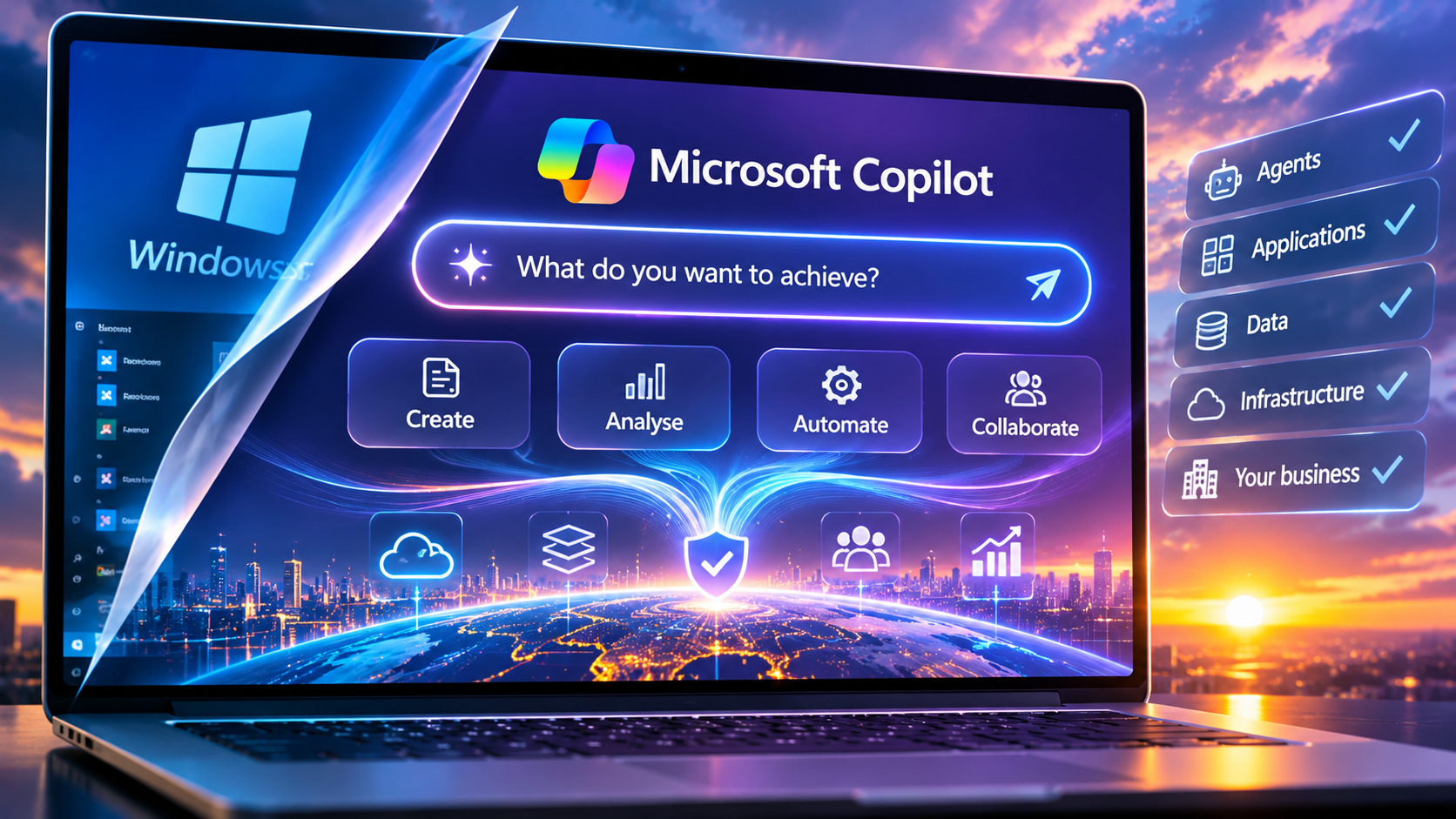
Two months later, Microsoft’s Ignite 2026 announcements provide striking evidence of that transition. Copilot is increasingly becoming the front door to computing. Word, Excel, Outlook and other applications are evolving from destinations we visit into capabilities invoked by AI. Windows remains underneath, but the user increasingly interacts with an intelligent orchestration layer rather than the operating system itself.
The operating system isn’t disappearing. Our need to know it exists is, as we move through the evolutionary steps from applications to intent.
This wasn’t my only prediction. In October, I wrote about the agent becoming the interface, a primary AI orchestrating specialist agents, applications and services on our behalf. Microsoft’s Copilot Home, Cowork, AutoPilot and expanding agent ecosystem now illustrate precisely that direction.
I also argued that computing would evolve into a dynamic fabric, with workloads distributed across personal devices, enterprise infrastructure and cloud platforms according to capability, cost, sovereignty and security. Microsoft’s hybrid intelligence strategy (Microsoft IQ) points towards that future.
These developments represent more than another software upgrade. They fundamentally change how we consume technology.
For decades, the digital economy has been organised around applications, platforms and the human skills required to operate them. AI threatens to invert that relationship. The application becomes a commodity. The interface becomes conversational. The economic value migrates towards whoever controls the intelligence, context, orchestration and authority through which work gets done. That has profound implications for software vendors, employment, competition and digital sovereignty. I predict that the new battleground is control of the Machine(s).
My subsequent articles, including ‘Who Gave the Machine Permission?’ and ‘The Architecture of Authority‘, explored what I believe is the inevitable consequence.
As AI moves from answering questions to executing decisions, the central security problem changes. An authenticated agent with legitimate permissions can still make a catastrophically wrong decision. Traditional identity controls and model guardrails are insufficient when machines can autonomously move money, alter infrastructure, disclose information or commit organisations to contractual obligations.
Microsoft’s Agent 365, Agent Grid and managed execution environments demonstrate growing recognition of this challenge but managing agents is not the same as independently governing their authority. We should not have to trust an AI model to remain trustworthy in order to trust the environment in which it operates. The architecture must enforce boundaries independently of the intelligence, continuously validating delegated authority, permitted actions, consequences and evidence.
So what lurks beyond Copilot, and could be the logical next evolution? Follow this trajectory and several further developments become increasingly plausible.
- Applications will become largely invisible services, competing to be selected by autonomous agents rather than discovered by humans. Traditional software distribution and licensing models will face disruption.
- Personal and enterprise agents will negotiate with other agents, purchasing services, coordinating resources and executing transactions at machine speed. Entire commercial processes could operate with minimal human intervention.
- Computing infrastructure will become increasingly abstracted. Agents will dynamically select execution environments according to performance, jurisdiction, trust and economic conditions.
- Digital identity will evolve beyond authenticating people and machines towards proving delegated authority, intent and accountability for individual actions.
Most fundamentally as I have threaded through most of my recent missives, assurance must become continuous and embedded within execution itself. Annual audits, static supplier questionnaires and point-in-time assessments cannot adequately govern an economy operating autonomously at machine speed.
As for the bigger societal question, I see this transformation democratising computing, dramatically increase productivity and remove barriers between human ambition and technological capability.
And therein lies a duality. It is already equally concentrating unprecedented economic power among those controlling the interfaces, identity systems and execution infrastructure through which society increasingly operates.
If one intelligent interface mediates our access to information, commerce, employment and public services, who determines which options it presents, which providers it selects and whose interests it serves? As explored in the though piece ‘The Trojan Model … Hidden Bias, Digital Lobotomies and the Illusion of Trust‘.
The risk is not simply that AI makes mistakes. It is that society becomes dependent on autonomous decisions it cannot independently inspect, challenge or reverse and the individual loses fundamental cognitive autonomy. Again I explored this earlier in ‘Is AI The Digital Crack Cocaine of the Century?‘, quiet possibly the answer is YES.
Microsoft’s announcements suggest that the future I described is arriving faster than many expected, but the next question is considerably more important than whether Windows disappears. When AI becomes the interface to the digital economy, who governs the authority behind it and who assures that authority remains accountable to us?
That, I suspect, will define the next decade of digital trust.
Leave a Reply