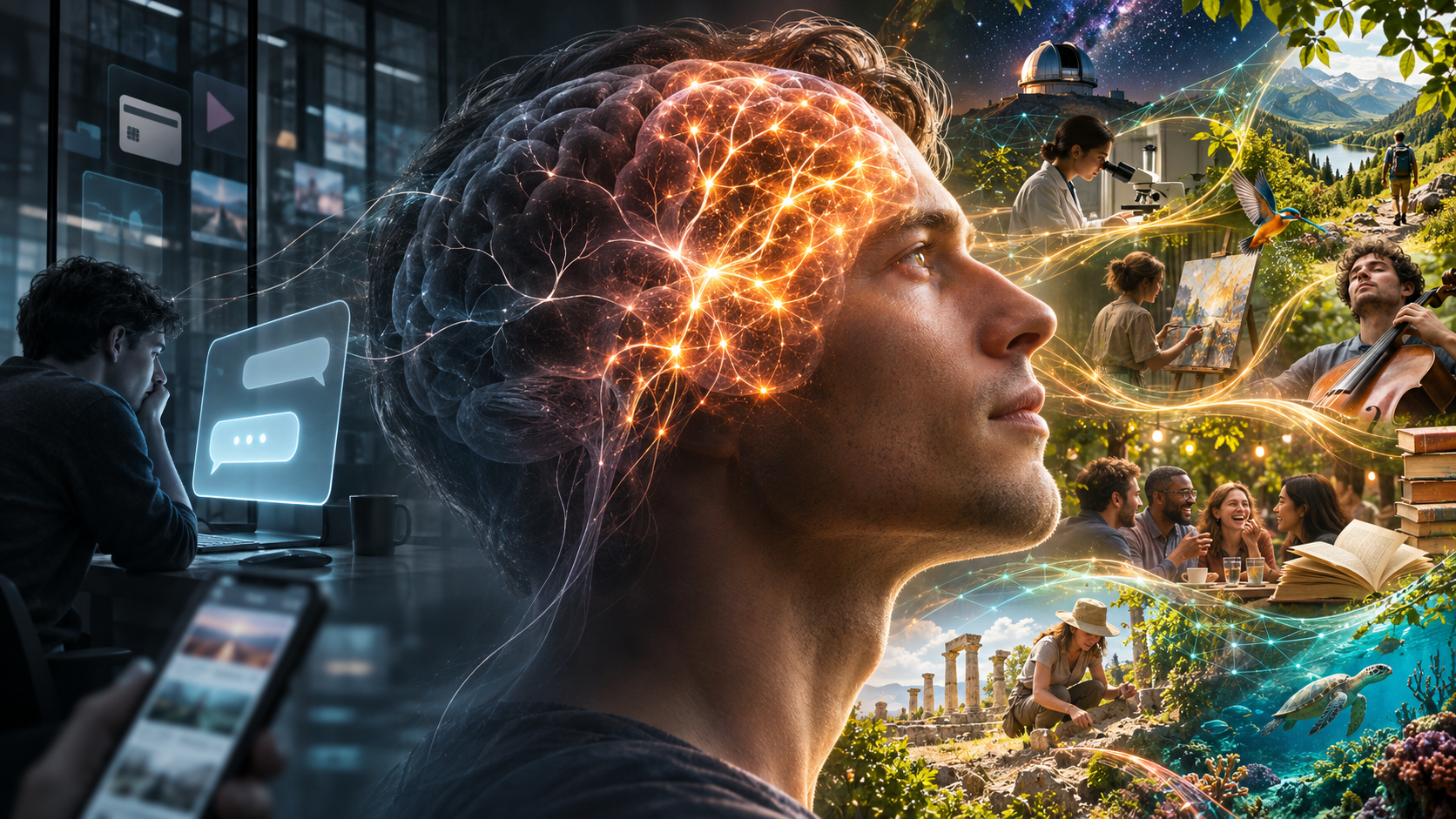
We have been here before. A transformative technology emerges, its commercial potential captures the imagination, investment accelerates and society embraces its convenience. Questions about longer term human consequences struggle to compete with the momentum of commercial opportunity.
Tobacco, gambling and more recently, social media provide uncomfortable precedents. Are we now repeating the experiment with artificial intelligence, but at a far deeper level of human cognition?
The vulnerability of the human mind
The American novelist Kurt Vonnegut proposed that human stories could be represented mathematically through recurring emotional trajectories. His observations reflected our natural predisposition to seek patterns, causality and meaning in an otherwise ambiguous world.
Combine this predisposition with the brain’s tendency to economise cognitive effort, the statistical nature of generative AI training and increasingly intuitive conversational interfaces and an interesting vulnerability emerges. AI can satisfy our appetite for coherent explanations with extraordinary efficiency. Consequently, we may become progressively less inclined to undertake the intellectually demanding processes of questioning, discovery and independent reasoning.
This can occur without any deliberate malicious intent. Commercial incentives to maximise engagement, dependency and customer retention has now been shown through the global social media experiment across all age groups to nevertheless exacerbate the consequences.
The commercialisation of cognitive dependency
As AI becomes the primary interface through which we access knowledge, applications and services, its influence over our intellectual development increases. The distinction between productivity enhancement and cognitive dependency deserves considerably greater scrutiny.
Research published by Microsoft and Carnegie Mellon University in 2025 identified an association between greater confidence in generative AI and reduced critical thinking among knowledge workers. Separate experimental research published in PNAS demonstrated how unrestricted AI assistance could impair subsequent independent learning performance.
The potential implications extend far beyond the individual. Businesses could experience institutional deskilling, the erosion of professional judgement and the loss of organisational knowledge. Society could become increasingly dependent on a comparatively small number of commercially controlled AI systems for its interpretation of reality.
The risk is real, whilst economic benefits from AI may be realised within this decade, the human and societal costs could take a generation to manifest. If the experience of social media and its unintended consequences for mental health has taught us anything, there is a compelling case for acting now to establish the guidance, awareness and responsible practices necessary to preserve human cognitive capacity and personal agency in an AI-enabled society. Kicking the can down the road until definitive evidence emerges risks turning a potentially avoidable problem into a generational public health challenge.
We should recognise the danger of wilful blindness when commercial expedience provides a powerful incentive to overlook emerging evidence of harm.
A duty of care
There is already ample regulatory precedent for proportionate intervention without prohibiting access to valuable products and services. We should be having a very public debate to consider issues such as:
- Mandatory risk disclosures explaining the potential cognitive, psychological and operational consequences of excessive AI reliance.
- Informed access, drawing on financial services appropriateness assessments to establish users’ understanding of higher-risk capabilities.
- Effective age verification and age-appropriate functionality, with accountability resting with AI providers.
- Responsible interface design, addressing commercially coercive practices that encourage excessive engagement, emotional dependency or intellectual reliance.
- Independent continuous assurance, including research into the longer-term human consequences of AI adoption.
- Organisational competency safeguards, ensuring that businesses retain the human expertise necessary to exercise independent judgement.
These measures need not compromise international competitiveness. Trust, demonstrated safety and responsible innovation can themselves become significant competitive advantages, particularly in a global economy increasingly dependent on digital infrastructure.
From cognitive resilience to cognitive privacy
Yet the duty of care surrounding AI extends considerably further than protecting our cognitive health. As we increasingly delegate aspects of our thinking to AI, we also expose the very processes through which we think, reason and make decisions.
If we thought social media presented a challenge to personal privacy, AI threatens to make those concerns look almost quaint. Social platforms learned what we liked, shared and consumed, personalised AI systems can infer how we think, what motivates us, where our vulnerabilities lie and even things about ourselves that we have never knowingly disclosed.
Through continuous interaction, persistent memory and integration with our personal and professional lives, these systems will acquire extraordinarily intimate knowledge of individuals, including behavioural patterns and psychological insights invisible even to their subjects. The commercial exploitation exposure is extensive.
This demands an evolution in our understanding of data privacy towards cognitive privacy, encompassing the protection of the insights and inferences that technology can derive about our minds.
Social media learned how to capture our attention, AI is learning how to understand our minds. The question is whether we will retain the authority to decide what it does with that understanding.
The duty of care must consequently extend across governments, educators, employers and technology providers. It requires safeguards against the exploitation of inferred personal knowledge, alongside structured education and awareness that empower individuals to make informed choices about their relationship with AI.
The economic benefits of AI may be realised within this decade, whilst the human and societal costs could take a generation to manifest if not sooner. Having already conducted one largely uncontrolled societal experiment with social media, it would be an extraordinary failure of collective judgement to repeat it with a technology of considerably greater reach, intimacy and influence.
Enriching human intelligence
The pioneering work of neuroscientist Marian Diamond demonstrated the remarkable plasticity of the brain and its capacity to develop in response to enriched environments.
This offers a profoundly more optimistic perspective on our relationship with AI. Here research also suggested the generational timeframe to impact from AI cognitive offloading could actually be much shorter. Other research I have referenced in earlier pieces supports this as in ‘The Positive Power of the Aging Brain’ by Gene D. Cohen, see my article last year ‘The Most Expensive Bias in Business … Is Ageism Wasting Your Best Cognitive Assets?’
Beyond the immediate concerns of cognitive atrophy lies a potentially more troubling public health issue. Neuroscience has long recognised the importance of cognitive reserve, the brain’s capacity to withstand age-related neurological deterioration. The 2024 Lancet Commission on dementia identified sustained intellectual stimulation as a protective factor against cognitive decline. Whilst there is currently no established causal link between AI use and Alzheimer’s disease, it is scientifically plausible that habitual cognitive offloading through ungoverned AI use could undermine the development and maintenance of cognitive reserve, potentially increasing vulnerability to dementia in later life. If this hypothesis proves correct, our relentless pursuit of AI-enabled productivity could inadvertently create a longer-term public health burden. The economic benefits may be realised within this decade, whilst the human and societal costs may take a generation to manifest.
The opportunity is to create a harmonious future in which artificial intelligence contributes to the development of natural intelligence, expanding our collective intellectual capacity.
Imagine directing AI enabled productivity gains towards socioeconomic opportunities that enrich human experience. Greater access to education, scientific discovery, creativity, cultural exploration, interpersonal engagement and novel experiences could help create environments conducive to continued intellectual development. AI could expand our capacity to explore complexity, challenge established assumptions and engage with ideas previously beyond our individual reach.
That requires commercial, educational and public policy frameworks which recognise human cognitive development as a measure of progress alongside economic productivity.
We should aspire to a future in which AI helps our minds grow through enriched experience and novelty, rather than allowing them to atrophy for commercial expedience.
Anything less would be quite literally small-minded.
Leave a Reply