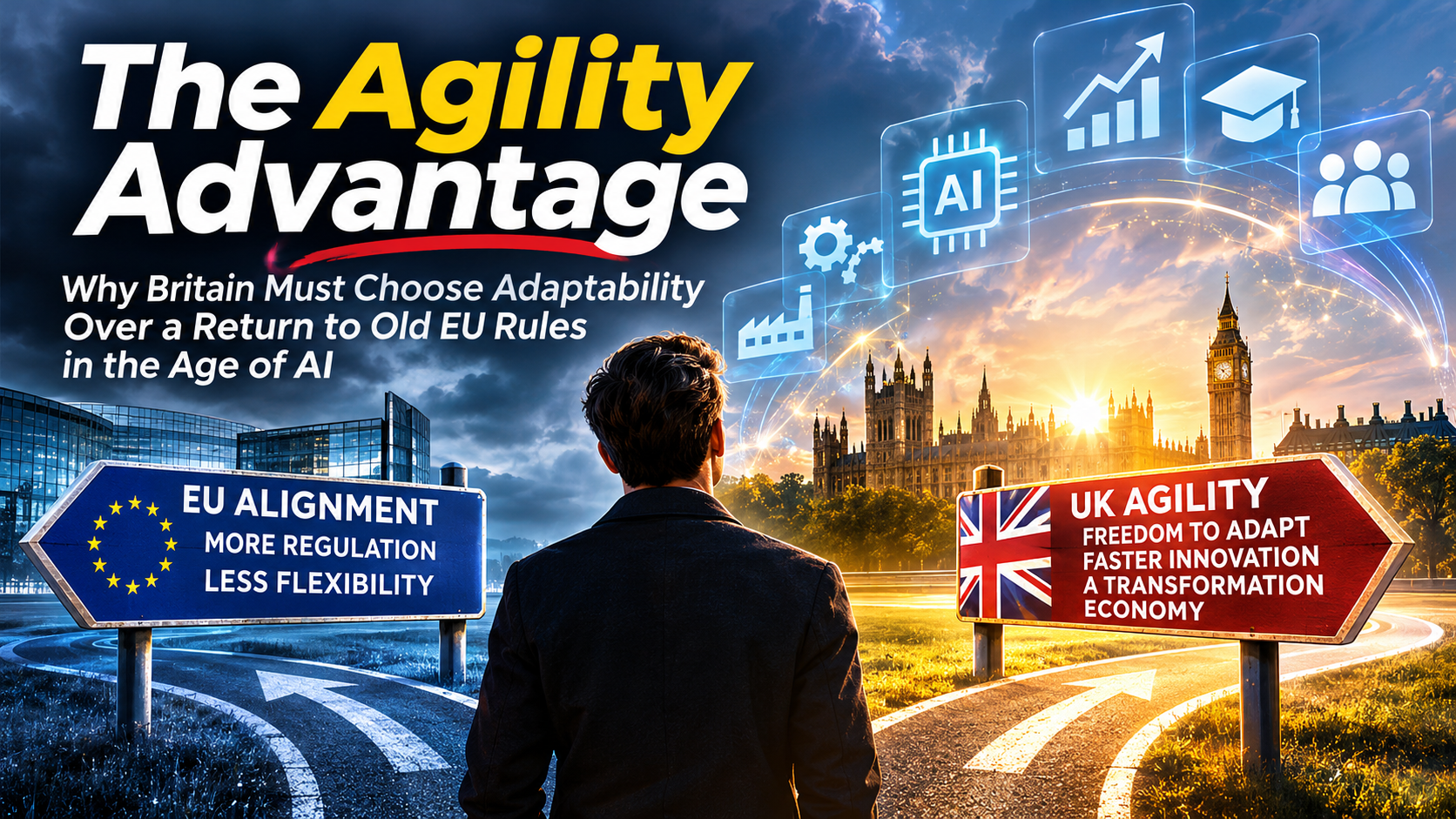
AI is making continuous transformation the new business operating model. Yet Britain’s employment legislation, education system and economic policies remain anchored in a world where change was the exception rather than the norm.
The Industrial Revolution transformed employment over generations. Digitalisation reshaped industries over decades. Artificial intelligence is now challenging business models, organisational structures and the economics of labour in months.
We are entering an era in which transformation is no longer something businesses undertake periodically. Continuous transformation is becoming the business operating model itself. Yet much of Britain’s economic and political thinking remains rooted in an industrial-era assumption: that businesses, occupations and working arrangements are relatively stable.
This growing disconnect may prove more economically damaging than AI driven job displacement itself.
When Transformation Becomes the Operating Model
In my earlier article, Are You Transforming with AI or Just Optimising?, I questioned whether businesses were genuinely transforming or simply using new technology to optimise established processes. That distinction is becoming fundamental.
AI is not merely another productivity tool. It is changing how organisations create value, make decisions, deploy resources and interact with customers. Across financial services, manufacturing, professional services, retail, hospitality and healthcare, activities previously dependent on rigid departmental structures and established workflows can increasingly be reorganised around intelligent systems and human expertise.
The implications extend well beyond automation. Organisations must become capable of continually redesigning themselves as technology evolves, customer expectations shift and new economic opportunities emerge.
The traditional business model assumed periods of relative stability interrupted by occasional transformation programmes. The emerging model assumes continuous transformation, interrupted only by the temporary stability necessary to operate. That demands unprecedented organisational agility, and fundamentally different expectations of the workforce.
Labour Markets Designed for Yesterday
Britain’s Employment Rights Act 2025 illustrates the challenge. Strengthening protections against exploitative employment practices is a legitimate objective. However, forthcoming provisions concerning guaranteed hours, shift notifications and short-notice changes risk adding complexity to employment arrangements at precisely the moment businesses need greater adaptability.
Hospitality provides an obvious example, with fluctuating customer demand requiring flexible staffing but the underlying issue is far broader. As AI changes business operating models, organisations across almost every sector will need to reconfigure teams, responsibilities, skills and working patterns more frequently.
Employment structures that assume relatively fixed roles and predictable organisational requirements may become increasingly disconnected from commercial reality. Importantly, flexibility must work for employees as well as employers. Economic agility cannot simply mean transferring business uncertainty onto workers.
The challenge is to develop employment arrangements that combine security, mobility, adaptability and opportunity.
AI is Automating Tasks but We are Eliminating People
Business leadership faces an equally troubling contradiction. AI is currently transforming individual tasks across many occupations, yet organisations frequently evaluate its benefits through the traditional economics of headcount reduction. This confuses automation with transformation.
Decades of digitalisation have institutionalised much of the workforce, programming people into repetitive processes, prescribed behaviours and increasingly monotonous working environments. We have spent decades teaching people to behave like machines. Now that machines can perform many of those activities, our instinct is to remove the people. Surely we should be doing precisely the opposite?
AI offers an extraordinary opportunity to liberate employees from routine activities, restoring creativity, autonomy, innovation and human judgement. The objective should not simply be fewer employees performing existing work more cheaply.
It should be people capable of creating considerably greater economic and social value alongside intelligent machines.
That requires an employment system designed around evolving capabilities rather than increasingly obsolete job descriptions and regressive employment practices being enforced on industry.
Education Must Transform Alongside Employment
This challenge begins long before someone enters the workforce. In my earlier article, Are Universities Educating Students for a World That Is Disappearing?, I questioned the relevance of an education model built around acquiring knowledge when AI is making knowledge and analytical capability increasingly accessible.
The same question now confronts our entire education system. Why are we still predominantly preparing young people for relatively stable careers when the economic environment they enter will demand continuous adaptation? The traditional model of education, qualification, employment and eventual retirement increasingly looks disconnected from the emerging reality.
Learning must become continuous, integrated into employment and accessible throughout working life. Educational institutions should increasingly prioritise critical thinking, judgement, creativity, resilience, adaptability and the ability to direct and challenge machine intelligence.
A continuously transforming economy requires a continuously learning workforce. Without that connection, AI driven productivity gains risk becoming concentrated among a relatively small proportion of businesses and workers while others are progressively marginalised.
Britain’s Post-Brexit Opportunity
This brings us to Britain’s evolving relationship with the European Union. The Labour government’s pursuit of closer European regulatory alignment is intended to reduce trade friction and improve economic cooperation. Those objectives have commercial merit but there is a wider strategic question that deserves considerably more attention. As geopolitical relationships shift and AI accelerates economic transformation, Britain is in a unique position to preserve much of its regulatory independence to shape its own response.
Brexit created greater freedom for Britain to determine its own employment policies, skills development, industrial strategy and approach to emerging technology regulation. That autonomy is not without economic cost, nor does it automatically deliver growth. It is an opportunity that demands vision, ambition and decisive leadership qualities that appear woefully absent from the current political landscape.
Instead, we are subjected to increasingly cynical ministerial rhetoric about reversing Brexit, seemingly forgetting that such a fundamental constitutional change should require a fresh democratic mandate. Such posturing is hardly befitting the offices these ministers hold and is deeply unconstructive at a time when Britain should be exploiting its newfound freedoms rather than continually revisiting yesterday’s arguments.
The real political failure is not Brexit itself, but the apparent inability of those governing Britain to recognise, let alone exploit, the opportunities it created.
The EU remains an essential economic partner, yet some of the world’s fastest growing major economies lie beyond Europe. Greater alignment in selected areas may reduce commercial barriers. Equally, unnecessary regulatory convergence could constrain opportunities for differentiated approaches.
Britain has the opportunity to develop an economic model combining international trade, technological innovation and a labour market designed for continuous transformation.
The objective should therefore be neither isolation nor alignment for its own sake.
It should be the freedom to build the most adaptable economy possible, cooperating internationally wherever that strengthens competitiveness.
For a country of Britain’s size, agility in an AI global digital economy will become a significant competitive advantage but only if political leadership recognises that regulatory freedom is something to exercise intelligently, not merely a constitutional status to preserve.
The Leadership Challenge
Britain’s future competitiveness will depend on how effectively government, business and education adapt together. Employment policy cannot be developed independently of technological transformation. Education cannot continue preparing people primarily for occupational structures that may be fundamentally reorganised and economic strategy cannot assume that the institutions and regulatory approaches of yesterday will necessarily serve the opportunities of tomorrow.
What concerns me is the apparent persistence of short term, institutionally conditioned thinking in both Westminster and the boardroom.
Businesses see AI more as a mechanism for reducing overhead, than the opportunity it offers for growth. Policymakers focus on regulating established employment arrangements. Educational institutions continue refining models developed for an economy that is rapidly disappearing. Meanwhile, AI is changing the foundations upon which all three depend.
Britain has an opportunity to approach this differently, to build an economy in which continuous transformation, lifelong learning, workforce adaptability and human creativity become mutually reinforcing foundations of prosperity. That should be the ambition.
A Warning to Westminster
A final word to our ministers, legislators and regulators. While you are busy determining precisely when, where and how people should work, AI is fundamentally changing what work actually means.
While you debate the merits of returning to familiar European regulatory structures, the global economy is being reshaped by technologies that pay little attention to traditional institutional boundaries and demand agility and adaptability. Two traits inconsistent with EU decision making DNA.
While our education system continues preparing young people for established occupations, AI is already rewriting the capabilities those occupations require.
Britain could conceivably achieve the distinction of having the most comprehensively regulated workforce in its history, educated for occupations that are disappearing, operating within business models already overtaken by technology.
The danger isn’t that AI will make British workers redundant, but that our politicians may make Britain redundant first.
Leave a Reply